Same Song, Completely Different Feeling: The Radio Effect Science Can't Fully Explain
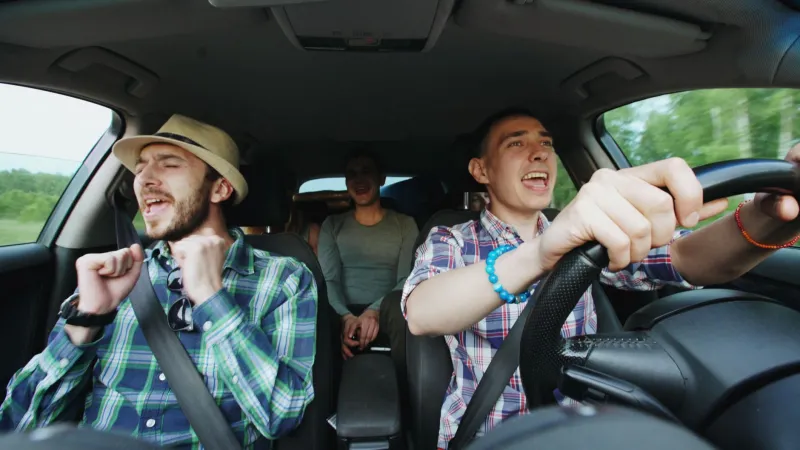
Picture this: you're driving home, half-checked out, scrolling through the mental to-do list in your head. Then a song comes on the radio — one you already have saved, one you've heard a hundred times — and suddenly you're turning the volume up, maybe even singing along louder than you should at a red light. Nobody asked you to feel that. It just happened.
Now flip the scenario. Same song, your own playlist, your couch. It's fine. It's good, even. But it doesn't quite hit the same way.
What's going on there? It turns out the gap between those two experiences isn't just in your head — or rather, it is in your head, and that's exactly the point.
The Control Paradox
Streaming gave us something genuinely incredible: total control. You want to hear that Sabrina Carpenter track at 7 a.m. on a Tuesday? Done. You want to shuffle through three different artists without a single commercial break? Easy. But here's the weird thing about control — sometimes having too much of it takes something away.
Psychologists call this the "paradox of choice," and it shows up everywhere from restaurant menus to dating apps. When you have unlimited options, the weight of any single choice gets lighter. You picked that song, which means you could have picked anything else. It's yours, sure, but it's also just... one of many.
Radio flips that dynamic completely. You didn't choose the song — the DJ did. And that small shift in agency changes how your brain processes the whole thing. There's a low-level anticipation baked into radio listening that streaming simply can't replicate, because you genuinely don't know what's coming next.
The Moment Before the Drop
Star 94 DJ Marcus Cole puts it simply: "There's this split second when a song starts and a listener realizes what it is — that recognition moment. On radio, you can't skip to it. You have to wait for it, and the waiting makes it mean more."
He's describing something music psychologists actually study. Anticipation triggers dopamine in the brain before the reward even arrives. When you're streaming and you tap a track, that anticipation window is basically zero — you already know what you're getting. But when a DJ builds into a set, layers a transition, or drops a track after a quick tease, your brain is working to figure it out. That tiny mystery is doing a lot of emotional heavy lifting.
Marcus says he thinks about this every time he structures a show block. "I don't just play hits back to back. I'll slow the energy down a little, let the audience kind of exhale, and then when I come back with something big, it lands harder. You're giving people a reason to feel the song again."
You're Not Listening Alone
There's another layer here that goes beyond individual psychology: community. When you stream a song by yourself, it's a private experience. When you hear it on Star 94, you're sharing that moment with however many people are tuned in across your city — in their cars, at their desks, on a job site, in a gym. That's not a small thing.
Sociologists who study music behavior have noted that shared listening creates what some call "collective effervescence" — a kind of low-grade emotional electricity that comes from knowing you're experiencing something simultaneously with other people. It's why concerts feel transcendent even when you can listen to the same songs at home. It's why people still gather around a TV for live events in the streaming era. Shared time has a different texture than solo time.
Radio taps into that instinct without you having to do anything. You're just tuned in, and so is everyone else.
Star 94's afternoon host Jenna Reyes has felt this from the other side of the mic. "Listeners will text in or hit us up on social saying 'you just played my song' — and it's a track they've heard a thousand times. But hearing it on the radio made it feel like a gift, like it was picked for them. That connection is real. I feel it too when I'm the one playing it."
Discovery Still Matters, Even for Known Songs
Here's a counterintuitive truth: radio can make you rediscover songs you already know. When you control your own queue, you tend to listen to music in context you've already assigned to it — that song is for working out, this one is for winding down. The associations are locked in.
But when a DJ plays the same track in a different context — sandwiched between two songs you wouldn't have put it next to, played at a different time of day, introduced with a quick bit of commentary — your brain engages with it differently. You're hearing it fresh, in a way, even if you've technically heard it dozens of times.
Marcus describes this as "recontextualization" and says it's one of his favorite tools. "I'll play a slower pop ballad right after something uptempo and watch how the texts change. People who said they were tired of that song suddenly say it's hitting different. The song didn't change. The frame around it did."
What Streaming Gets Right — And What It Misses
None of this is a knock on streaming. Platforms like Spotify and Apple Music have genuinely transformed how people build relationships with music, and the data-driven personalization they offer is impressive. Your Discover Weekly playlist has probably introduced you to artists you genuinely love.
But algorithmic curation and human curation are doing different jobs. An algorithm optimizes for what it predicts you'll like based on past behavior. A DJ is reading a moment — the time of day, the mood of the city, what's happening in culture right now — and making a human judgment call. One is efficient. The other is alive.
Jenna says that distinction matters to her listeners more than people might expect. "People tell me all the time that they like not knowing what's coming. They trust us to take them somewhere. That trust is the whole thing."
Why the Radio Moment Still Owns the Room
In a world where you can technically hear any song ever recorded within about three seconds, the idea that radio still creates a distinct emotional experience sounds almost quaint. But the numbers, the listener feedback, and honestly just common sense back it up.
Something about a song arriving unexpectedly, from a human hand, in a shared moment with a city full of strangers — it changes the song. Not forever, not chemically. But in that moment, it feels like yours in a way a queued-up track rarely does.
That's the radio effect. And no matter how good the algorithm gets, it's still chasing something it can't quite catch.